


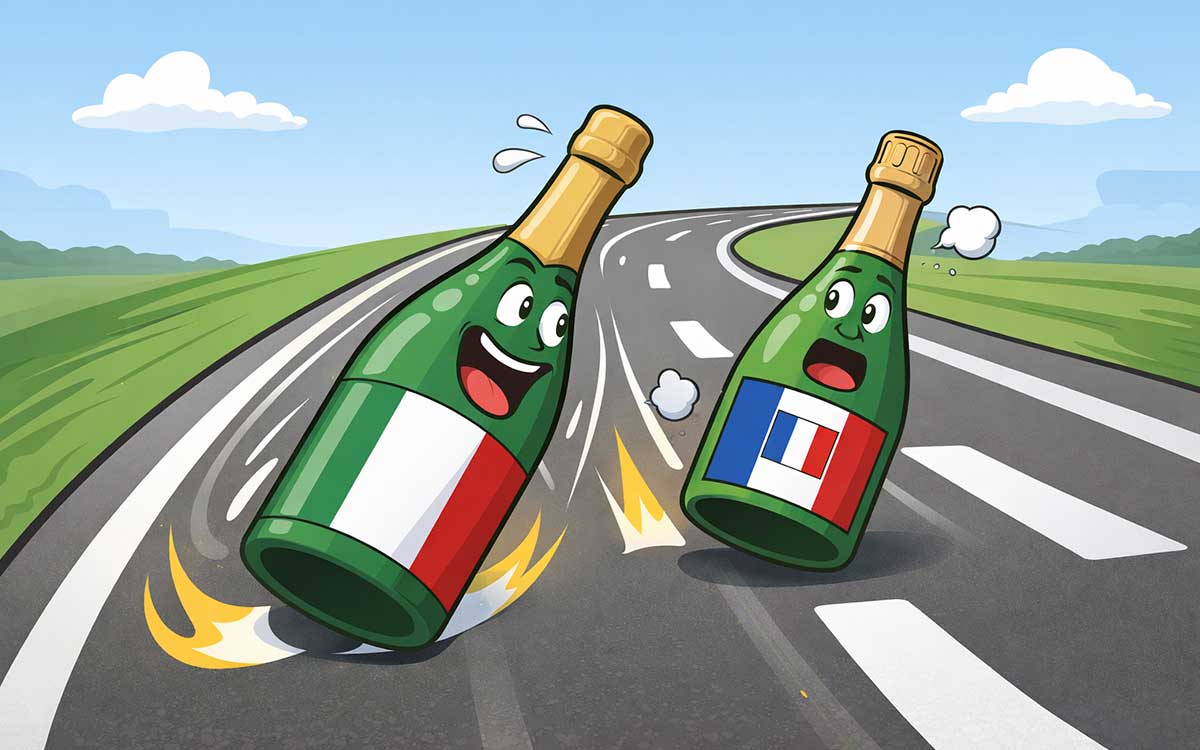
Prosecco Overtakes Champagne Italy’s Leading Sparkling Wine Export
Affordable pricing, fresh flavors, and efficient production methods have helped Prosecco become Italy’s top wine export worldwide. Over the past decade, Prosecco has gained strong momentum in international markets and even surpassed Champagne in global sales.
Produced mainly in the northeastern regions of Veneto and Friuli Venezia Giulia, Prosecco is now one of Italy’s most recognized sparkling wines. Its global success is driven by its approachable taste, versatility, and competitive price point.
Origins and History
The name Prosecco derives from a small village near Trieste, close to the historic Castle of Pucinum. In ancient times, the wine was known as Pucinum, but by the 16th century it was renamed Prosecco to distinguish it from other regional wines. The first documented reference dates back to 1593, when English traveler Fynes Moryson listed it among Italy’s finest wines.
Grape, Style, and Characteristics
Prosecco is produced primarily from the Glera grape. It has a bright straw-yellow color and fine, persistent bubbles. On the palate, it is light and fresh, with crisp acidity and fruity aromas, often showing citrus notes. Alcohol levels typically range between 11% and 12%, making it lighter than many other sparkling wines.
Until the 1960s, Prosecco was often sweet and lacked clear differentiation from other Italian sparkling wines such as Asti. Technological improvements in the late 20th century significantly enhanced quality standards. By the early 2000s, Prosecco entered the North American market, where it quickly gained popularity. Today, the United States is the largest importer, followed by strong demand in the United Kingdom. In 2010, Prosecco obtained DOC status, reinforcing its quality and authenticity.
Prosecco Classifications
There are two main categories:
- Conegliano Valdobbiadene DOCG Prosecco Superiore
- Prosecco DOC
Additional designations such as Rive and Cartizze identify specific vineyard areas.
Based on effervescence, Prosecco is classified as:
- Spumante (fully sparkling)
- Frizzante (semi-sparkling)
- Tranquillo (still, about 5% of total production and rarely exported)
Sweetness levels vary:
- Brut: under 12 g/l residual sugar
- Extra Dry: 12–17 g/l
- Dry: 17–32 g/l
- Demi-Sec: 32–50 g/l
Production Method: Charmat vs Traditional
Unlike Champagne and Cava, which use bottle fermentation (traditional method), Prosecco is made using the Charmat method. Secondary fermentation occurs in large stainless steel tanks rather than individual bottles. After producing a dry base wine, sugar, yeast nutrients, and clarifying agents are added in a sealed tank to trigger secondary fermentation under controlled conditions. Once carbonation reaches the desired level, the wine is filtered and bottled under pressure.
This method allows for faster production and lower costs, preserving the wine’s fresh fruit character while keeping prices accessible.
Why Prosecco Leads Global Exports
Prosecco’s refreshing profile and affordability make it ideal as an aperitif, with light dishes, or alongside desserts in sweeter styles. It is also widely used in cocktails such as the Spritz and Bellini.
Thanks to its easy-drinking style, adaptability, and efficient production, Prosecco continues to expand its presence in global markets, solidifying its position as Italy’s leading sparkling wine export.